Showing posts with label Cate Blanchett. Show all posts

Friday, February 16, 2007

The Good German

Starring the current Spiderman (Tobey Maguire), a former Batman (George Clooney) and the queen of the elves herself (Cate Blanchett), the heavyweight cast of 'The Good German' may lead you to believe it is a blockbusting 'event movie' of the Michael Bay or Jerry Bruckheimer variety, but this couldn't be further from the truth. Directed by Steven Soderbergh, this movie was billed as 'an experiment' for the director, one in which he only used equipment that was available in the 1940's. So, no zoom lenses, only one camera per shot, and hand-held boom microphones. We might be forgiven for asking, as John Stewart put to George Clooney in his Daily Show interview: "why!?".

Well, The Good German is a noir tale of suspense and intrigue, set against the backdrop of conflict-ravaged Berlin and Potsdam in 1945, just as WWII is drawing to a close. So the easy answer to John Stewart's question is really that the style of production just happens to suit the subject matter, and contributes to immersing the audience in the story.

Clooney plays a war-time correspondent for the U.S. forces, stationed in Berlin, with the nefarious Tully (Tobey Maguire) assigned as his driver. Tully is sleeping with Lena, the German referred to in the title, and she turns out to also be an old flame of Clooney's from the his previous Berlin assignment. Lena is played by Cate Blanchett, and her performance is noir femme fatale to a tee, effortlessly mixing the German accent of Marlene Dietrich with the smoking femininity of Lauren Bacall from the days of 'Dark Passage' and 'To Have and Have Not'. Her stand-out performance really out-shines her two super-hero co-stars, and PCMR must stop banging on about this, but she really is one of the best actresses working today. Even large amounts of German dialogue can't repress her ability to deliver each scene as capably as the last.

War-time Berlin was a place where, to put it mildly, many bad things happened. The characters in this movie espouse the belief that, after living in Berlin for a while, nothing surprises you any more. This is the backdrop for this intriguing story, and is also a classic element of many noir tales, detailing a micro-struggle set against the backdrop of a larger conflict. Every noir movie also needs a bar, a smoke-filled sleazy den, housing shady characters, military men, and dangerous women, all with an angle to work and a story to tell. The Good German is no different, and in these scenes, the barman, played by the Scot Tony Curran, has some great lines. His genuine Scottish accent seems a little out of place in war-time Berlin, but this adds to his character, and he has some memorable moments.

It was a strange experience for PCMR, watching this one at 10.30 a.m. on a Saturday morning, but in a strange way, the timing seemed appropriate to the lazy pace of the movie. I don't want to give away too much of the plot, mainly because there is too much detail to cover, but also because every little detail gradually builds the plot, and contributes to the outcome of the story. Like every noir movie should, The Good German twists and turns, with your opinions of characters never allowed to settle as they gradually reveal their cards, and what they have at stake.

The noir tradition was established by Hollywood classics of the 40's and 50's, and is populated by such legends as Peter Lorre, John Huston, Lauren Bacall, Marlene Dietrich and the man himself, Humphrey Bogart. Roman Polanski also added a benchmark to the genre in 1974, when he teamed up with screenwriter Robert Towne, Faye Dunaway and a certain Jack Nicholson to produce one of PCMR's all-time top movies 'Chinatown'. (Wasn't John Huston in that too? - Ed). The Coen brothers have even done a noir flick, receiving a more mixed reaction with their slickly shot 'The Man Who Wasn't There'.

The point of this little noir history lesson is that Steven Soderbergh is attempting to move into an illustrious neighbourhood with this movie, and is harking back to an established style that has been well-defined by some of the cinematic greats. Indeed, for much of the movie, Clooney sports stitches in his cheek and a bandage on his ear, in a thinly disguised nod and wink to Jack Nicholson's 'Chinatown' nose plaster. Also, the closing scenes of The Good German, set as they are in a military airfield, are a very obvious reference to the iconic ending of 'Casablanca', with driving rain substituted for the misty setting of - arguably - Bogie's most iconic cinematic moments. Soderbergh and writer Paul Attanasio avoid the temptation to refer directly to Casablanca in the dialogue, but the similarity of these scenes must have been intentional.

The style imposed by the constraints of the equipment used gives the movie a real old-school feel, continually reinforcing the noir atmosphere. Clooney's idiosyncratic charisma is reinforced by the black-and-white film, and he delivers a capable enough performance. Also, Tobey Maguire does a very good job as the dodgy geezer Tully, but Blanchett's performance is the real reference point of the flick. She played Hepburn in 'The Aviator', and her mysterious character in this movie is definitely a little Dietrich. Her femme fatale is the main driver behind Clooney's investigations, which gradually uncover a multi-layered mystery involving the american military, the enemy, and a possible cover-up of something really quite heinous.

It's unfortunate for 'The Good German' that the noir genre is so well-defined, because it's really quite a good movie in it's own right, so to compare it to, say 'Chinatown', is unfair. For me, Soderbergh's 'experiment' is more than that, as the movie is slickly shot, very well acted by the three leads and an excellent troupe of talented support actors - Beau Bridges amongst them. The plot is immersive, and the inter-mixing of stock showreel footage from that era contributes to separating the acts, and also placing the audience in this time and place. The story also has contemporary relevance, relating as it does to Clooney's growing discomfort at the fact that his own military superiors may not be acting with the moral fibre one would expect from people in the seat of power. (Shady politicians? Perish the thought! - Ed)

However, despite all it has going for it, if I was going to pick holes, I felt the pace of the action dragged a little in the denouement (That'd be 'the ending' then.. - Ed), and I wasn't as attached to the outcome of Clooney's story as I was to Cate Blanchett's character. Overall though, it was a very enjoyable way to spend a Saturday morning, and I'm quite surprised that 'The Good German' was pretty much overlooked by Oscar, garnering as it did just the single nomination for music.


The verdict: Immersive, atmospheric and well-acted, but just a tad drawn out in the end.
The rating: 7/10

Wednesday, January 31, 2007

Babel

The Book of Genesis has been crowbarred into a couple of high-profile cinema releases of late. In Darren Aronofsky's 'The Fountain', we were reminded of the story of Adam and Eve, but with an eye on a relatively under-publicised aspect of that story, namely the Tree of Life. In 'Babel', Alejandro Gonzalez Inarritu's third major feature film, we are reminded of the story of the mythical Tower of Babel.

Just in case you've lived under a large rock all your life, the parable of the tower of babel tells of an ancient time when the peoples of the earth all worked together to build a tower so tall that it would reach the skies, and man could be closer to God. When God saw what man was striving for, he became angry. His punishment for man's endeavour was to scatter the population across the world, and create the barrier of language, so as to divide men, and forever prevent them from working together in such a unified manner again.

Inarritu's movie is different from The Fountain, in that it does not include, or even refer to, to the bible story in question. Rather, the stories being told here relate to the theme of communication difficulties, and the problems faced by people in simply trying to cope with themselves and each other, often against the backdrop of a foreign or alien setting.

Inarritu is a firm believer in the Neapolitan Ice-cream art of film-making. That is, rather than focus on one straight-forward flavour or story, and exploit it to it's fullest, he tends to include three different stories for the delectation of the audience. This is an innovative approach to film-making and a formula that Hollywood has taken to it's collective bosom of late, with 'vignette movies' such as 'Crash' and more recently 'Bobby' rapidly becoming the new vogue in Tinseltown, and proving popular with audiences to boot.

In Inarritu's movies, common themes run through each of the three stories, but there is also a pivotal plot point where the three stories intertwine and influence each other. This plot point is in reality, often quite straight-forward. For example, in 'Amores Perros', the movie that attracted Hollywood to Inarritu's door, the device was dogs. In the (ironically) extremely heavy '21 Grams', the linking point was a heart transplant operation. In 'Babel' it is a rifle. However, even if the linkage device is straight-forward, it is in the exposition of the narrative, and the revelation of this device, where Inarritu employs his full bag of creative tricks.

To labour the Neapolitan metaphor a little, there is a problem with this type of ice cream: everyone has a favourite. The result of this is that the other two flavours become a little devalued, and we wonder why we didn't just buy strawberry ice cream in the first place. Specialise or diversify... it's a difficult one to answer. In 'Babel', the best story for me is the one set in Japan, where Chieko (Rinko Kikuchi) is a hearing-impaired teenager whose mother has recently died. Like any teenager, she's moody, and has problems communicating, but her handicap makes it more difficult to talk to boys her age, and this frustrates her even further. Her story is set against the backdrop of urban Japanese teenagers though, and it's fascinating to look through Inarritu's window into a world that is so foreign to our own. 'Lost in Translation' also played with this device, employing Japanese culture almost as an ominous supporting character in the movie.

The vanilla story - i.e. good, but not the best - is the one with the most recognisable faces. Brad Pitt and Cate Blanchett are a married couple on holiday in Morocco, and their marriage is obviously on the rocks. Meanwhile, a moroccan rural family purchase a rifle with which to keep jackals away from their goat herds, and the two young boys of the family are given responsibility for the weapon. When they test the rifle's range, they manage to hit Cate Blanchett, and this is the trigger moment for the three layers of the story to gradually melt into each other.

Finally, the chocolate story, or the one I would rank the lowest. A child-minder for a wealthy American family (Brad and Cate) is charged with looking after the two kids on her day off, but she also has to attend her son's wedding across the border in Mexico. In what proves to be the first of many bad decisions, she opts to take the kids with her across the border. Essentially, she has a pretty bad day after that, and this story is by a long way the weakest of the three.

Brad Pitt is very good in Babel, portraying his gradually increasing desperation and isolation very well. There are some nice moments where he befriends a Moroccan man, and they find they have quite a lot in common, despite his surroundings appearing so alien to our Brad. Cate Blanchett, unfortunately, is completely wasted in this movie. She has two scenes involving anything other than writhing in pain or screaming in pain, but, as you'd expect, she is excellent for those couple of minutes at least. The effect of the gunshot on the Moroccan family is more dramatic than the effect on Brad and Cate however, and this storyline is also well played out. The younger of the two brothers in particular is a great little character.

However, as with the strawberry part of the Neapolitan, I found that when I was watching my favourite - the Japanese story - I lost interest in the other two sections. Someone made the point to me recently that subtitled movies sometimes gain an extra layer of gravitas, simply thanks to the fact that they are in the foreign language. The character of the fawn in 'Pan's Labyrinth' is a great example of this. Would he be quite as interesting a character, or quite as threatening if he was speaking in English? It's difficult to say, but it's curious to me that the Japanese story the Moroccan family's story in 'Babel' and were the ones that held my attention the most, and both of these were in foreign languages.

Babel is a meandering, expansive tale that in the end, doesn't draw any big, important conclusions. However, it is at least a thought-provoking, well-crafted story, and definitely worthy of two hours of your time. Innaritu's critics may say that with the triple narrative device, he's becoming a one-trick-pony at this stage, but at least in this he has chosen to specialise, and focus on what he does best.

It is worth seeing Babel, because there aren't enough large-scale productions made with this level of thought and ambition. And who knows, come Oscar night it may follow in the footsteps of last year's bg vignette movie, Crash, and pick up the best picture Oscar gong. (Although PCMR's money is on Clint Eastwood's Japanese war movie: 'Letters from Iwo Jima')


The verdict: Intelligent and well-made, with a very self-important title, but no mind-blowing conclusions to draw.
The rating: 7/10

Monday, October 09, 2006

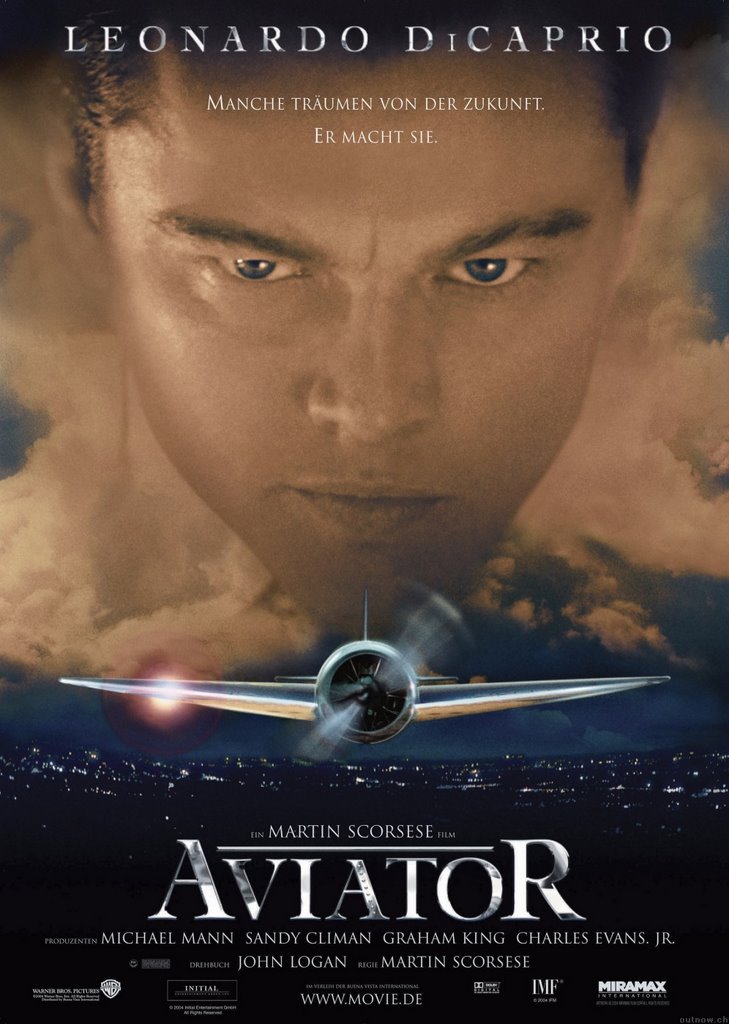
The Aviator

Martin Scorcese would be forgiven for having a chip on his shoulder where the American Motion Picture Academy are concerned. (Not that the lack of an oscar nod should get him down, considering the high level of quality he's managed to maintain over the last twenty years or so.) Despite the lack of oscar gold, his movies seem to grow in popularity year on year, as new audiences discover their dark delights. From his well-documented, and tempestuous working relationship with Robert DeNiro, which arguably produced career highs for both, to the now fledgeling Scorcese-DiCaprio love affair, the director has a knack for connecting with audiences, meaning that the box office is always good to Marty, whether the paperweight statuettes arrive or not.

With 'The Aviator', and 'Gangs of New York' before it, Marty has wholeheartedly tried to curry Oscar favour, but to no avail. Scorcese himself has admitted that he has now decided to shift his focus away from winning the oscar with his new offering 'The Departed' (review coming soon, folks) deciding instead to make a trademark Scorcese crime thriller that mass audiences could relate to... prioritising the audience above the academy if you like. Well, great! However, in advance of going to see 'The Departed' I decided to take a look at 'The Aviator', one I missed out on during its run in theaters.

If Scorcese has left behind the production values and style that make The Aviator such an lavishly entertaining motion picture, then that is perhaps the audience's loss. The production is big, colourful and packed with an all-star cast that dominate the screen. Leonardo DiCaprio plays the notorious Howard Hughes, after whom the film is named. This eccentric character certainly lived an extremely interesting life, and Scorcese has packed a hell of a lot of it into this two and a half hour movie, without ever letting the pace drag noticeably.

DiCaprio is not my favourite actor, but I found myself begrudgingly admiring his performance here. The role bears many of the hallmarks of a classic leading man in a Scorcese picture: larger than life character? Check. Noticeable physical transformation? Check. Descent into dark areas of the psyche? Check. Fans of Scorcese will recognize much of his signatures in the main protagonist in the Aviator. And I have to say, Leo does remarkably well in the role. He portrays Hughes as a tortured soul, and wins our sympathies early in the picture. Which is just as well, as he is in almost every scene of the film!

Cate Blanchett plays Katherine Hepburn, the love of Hughes' life, and where DiCaprio is very good, she is simply stunning, and fully deserved the Oscar gong she received for this role.

The support players are heavy weight, and all well cast: Alec Baldwin, Alan Alda, Jude Law, Kate Beckinsale, Ian Holm... the gang's all here! Even Gwen Stefani appears for a brief moment, prompting the suspicion that anyone might appear from one moment to the next (... and is that Rufus Wainright singing in the night-club?)

While the Aviator is is admittedly no 'Goodfellas', I contend that that ain't no bad thing, and would commend Scorcese for taking a step outside of his comfort zone. (And isn't any comparison with Goodfellas always going to be a little unfair?) Scenes of graphic violence are replaced with lavish special-effects driven moments telling the story of Hughes' aviatiory triumphs. These were no mean feats, and Scorcese ensures the images on screen evoke the grandeur they must have signified to cinema audiences of the day, watching Hughes' latest adventure unfold in newsreels before the main feature.

Hughes' mind was not always reliable however, and his descent from mild eccentricity into real mental illness is very well portrayed by DiCaprio on-screen, in an albeit cosmetic physical transformation, but one which renders him almost unrecognizable. For me though, despite DiCaprio's impressive performance, it is Blanchett who steals the show, and she must now be recognised as one of the best leading ladies working today.

The production is extravagant, lavish and colourful, and the screen is illuminated with real cinematographic skill, almost like Scorcese is saying to us: "look! see what I can do, dammit?! I don't need Joe Pesci!" (Or words to that effect!) However, it wasn't meant to be at the Oscars, and Million Dollar Baby stole the gong that night. In my opinion though 'The Aviator' is a far superior movie.

Fans of Scorcese will find enough to remind them of his more 'gangster' days, but the Aviator's impressive cast, and setting in the romantic heyday of the forties in Hollywood should mean it has reached a wider audience who will find more than his usual grit, dark insights and witty dialogue Scorcese is renowned for purveying. That said, I'm now really looking forward to seeing 'The Departed'!

Verdict: beautifully made story, well told and very well acted, a winner for Scorcese buffs and novices alike.
Rating: 7/10

/** Amazon Affiliates code /** Google Analytics Code